

Every fall my coop looks like a crime scene. Feathers everywhere, birds that will not make eye contact, and a nesting box that has gone completely quiet.
Nothing is wrong. This is molting, and it happens to every bird you keep. It happens to chickens, it happens to ducks, and it happens to geese in a way almost nobody warns you about.
The short version: as daylight shortens in late summer and fall, birds drop their old worn feathers and grow a complete new set before winter. Feathers are roughly eighty five percent protein, so rebuilding them takes everything a bird has. That is why laying slows down or stops completely. It is not illness and it is not the end of anyone’s laying life. They need more protein, fewer treats, and to be left alone for a few weeks. Then they come back better than they were.
And it is not only the girls. Roosters molt. Drakes molt. Ganders molt. Every feathered bird on your place goes through this, and the boys can look rougher than the hens do while it happens, because they have more ornamental feathering to lose.
What she needs right now
Feed
Higher protein than your usual layer feed. A standard layer runs around sixteen percent and a molting bird does better nearer eighteen. Keep it complete and balanced rather than stacking supplements on top of it.
Calcium
Oyster shell out on the side in its own dish, free choice, never mixed into the feed. The hens still laying will take what they need and the ones who have stopped will leave it alone.
Water
Clean and always available. Growing feathers is thirsty work, and ducks and geese also need water deep enough to submerge their heads so they can condition what is coming in.
Treats
Fine in small amounts, about ten percent of the day. Scratch and corn are low in protein, so past that point you are filling her up with the wrong thing.
Handling
Not this month if you can help it. Pin feathers are live and sore. Admire from a distance and save the lap time for December.
When to actually worry
A molting bird is scruffy but bright eyed, eating and moving around. Hunched, closed eyed, not eating, or standing off by herself is a different problem. So is bleeding that does not stop.
What molting actually is
A feather is dead once it finishes growing. It cannot repair itself, so a year of sun, rain, dust bathing and being stepped on by flockmates wears it out. The only fix available to a bird is to throw the whole set away and start over.
The trigger is daylight, not temperature. As the days shorten the body reads the signal and shifts every resource it has from making eggs to making feathers. A bird cannot do both well at the same time, so it picks the one that keeps her alive through winter. Feathers win. They always win.
This is also why a molt that starts in the fall is normal and one that starts in June is worth a closer look.
When it happens and how long it lasts
- The first adult molt comes around eighteen months old. A pullet raised in spring usually lays straight through her first winter and does not molt until the following fall. If your first-year birds are not molting, that is why.
- After that it is annual, most often from late August through November.
- Four to sixteen weeks is the normal range. Some birds are through it in a month and some take an entire season.
- Older birds molt longer and more slowly. A three or four year old hen often takes noticeably more time than she used to.
- A hard molt is faster. The birds that look worst are usually finished first.

Hard molt or soft molt
A soft molt is gradual. Feathers come out a few at a time over weeks and the bird never looks truly bad. You might only notice because the eggs slowed and the coop floor is untidy.
A hard molt is exactly what it sounds like. A bird can drop most of her feathers in a matter of days and end up looking plucked, with bare patches on her neck and back. It is alarming the first time you see it. It is also the faster route through, and those birds are usually the first ones laying again.
Neither one is better. It is largely down to the individual bird and her age.
Some breeds just look worse doing it
Meet Bette Davis and Joan Crawford. They are Frizzles, which means their feathers curl outward instead of lying flat, so they look windblown on their very best day. This is not their best day.

A Frizzle molt is the roughest looking molt on our place every single year, and there is a reason for it. The curl comes from a gene that changes the structure of the feather shaft, and the same thing that makes the feather curl also makes it fragile. Frizzle feathers break more easily and wear out faster than a smooth feather does, and there is no flat outer layer lying over the top to hide what is going on underneath. When a Frizzle drops her feathers, you see every bit of it.

Both of these girls are healthy. They are eating, they are bossing everyone in that run around, and they are sore everywhere a new feather is pushing through. In a few weeks they will be ridiculous looking in the good way again.
If you keep Frizzles or Sizzles, expect this, and expect to answer questions from anybody who walks past them. Their molt is not worse than everyone else’s. It is just louder.
What molting looks like on a rooster
A rooster in molt is a genuinely sorry sight, and people worry about him more than they worry about the hens.
He loses the showy feathers first. The long pointed hackle feathers on his neck and the saddle feathers over his back are what give him his shape, and when those go he can look scrawny and half his usual size. The tail is worse. Those big curved sickle feathers drop and leave him with a stub.
He may go quiet and lose interest. Less crowing, less strutting, less attention paid to the hens. Fertility usually dips through a molt, so if you are hatching eggs, this is not the window for it.
He needs exactly what they need. Protein, and to be left alone. A rooster in heavy pin is sore in the same places a hen is, and he will not thank you for picking him up to inspect him.
The good news is the same as it is for everybody else. He comes back out of it looking better than he went in, and by the time the tail grows back he is insufferable about it again.
Geese and ducks molt too, and it looks different
This is the part that catches people, because almost everything written about molting assumes chickens.
My Sebastopol geese go through it every year, and with a Sebastopol it is dramatic. Those long curled feathers are the whole point of the breed, and watching them come out feels like watching something go wrong. It is not.
Waterfowl drop their flight feathers all at once. This is the real difference. Chickens lose wing feathers gradually and stay more or less airworthy the whole time. Geese and ducks shed their primaries in one go and genuinely cannot fly for a few weeks. In the wild this is when they hide on open water.
Which means they are vulnerable, and they know it. Flightless birds are nervous birds. This is the time of year to be strict about secure housing at night and to accept that they may be less friendly than usual. They are not sulking. They are exposed and they feel it.
Geese also grow a lot of down. Ducks and geese are rebuilding an insulating underlayer as well as an outer coat, which is a real protein demand. Expect a big appetite.
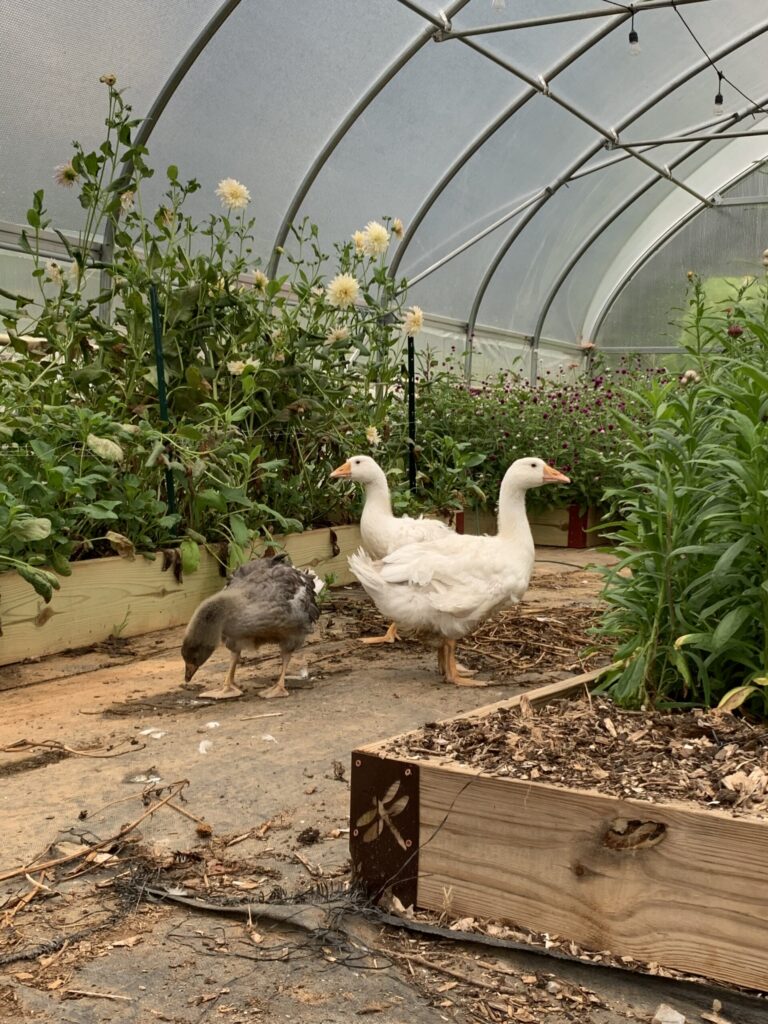
You will find feathers on the water and everywhere else. In my greenhouse I find them along the beds for weeks. If you keep waterfowl in a garden space the way I do, that is your reminder to check the setup you have for birds and beds together and make sure they still have somewhere safe to be while they cannot get away from anything.
One more thing specific to geese: a goose in molt should still have a clean dry place to sleep. Wet bedding against a body that is short on feathers is how a bird gets genuinely cold.

Ducks have a second molt nobody warns you about
Ducks go through the same flightless wing molt geese do, and then drakes do something extra.
The duck in these photos is Mayfield. He came to us as a rescue, he has a limp that has never seemed to bother him one bit, and twice a year he does this. The first time I watched him go from that green head into plain mottled brown, I understood exactly why people panic about it.
The eclipse molt. After breeding season a drake sheds his showy plumage and grows in a drab, female-looking coat. A handsome Rouen or Mallard drake can go from bottle green head and bright markings to plain brown in a couple of weeks, and people genuinely write in thinking their drake has turned into a duck. He has not. The curled tail feathers and the bill color usually still give him away, and his proper colors come back in fall.
So a drake may molt twice in a year, once into eclipse and once out of it. That is a heavier annual protein demand than a hen has.
Laying ducks stop laying too. Duck eggs slow or stop during the molt the same way chicken eggs do, and for the same reason.
Keep their water clean and deep enough to submerge their heads. Ducks preen new feathers constantly and they use water to do it. Pin feathers coated in mud do not open properly.

What to feed a molting bird
This is the single place where what you do actually changes the outcome. Everything else on this page is patience. This part is action.
Raise the protein. A standard layer feed runs around sixteen percent, which is built for making eggs, not for rebuilding an entire set of feathers. During molt my fancy coop goes on Purina Farm to Flock 18% Layer. That extra protein goes straight into feather growth, and you can see it in how fast they come back in.
Look for a complete feed, not just a high number. Protein is the headline, but a molting bird is rebuilding everything, so what else is in the bag matters. Purina Farm to Flock 18% Layer is whole grains, seeds and veggies rather than a plain pellet. Its Flock Strong system brings live probiotics, prebiotics and plant extracts. Balanced vitamins A, D and E plus marigold extract go toward good eggs and rich golden yolks. There is an Oyster Strong system in it for shell strength, which counts for the hens who keep laying straight through a molt. And it is complete and balanced, so I am not stacking supplements on top of it.
Snacks are fine, within reason. A few treats never hurt anybody who is not feeling their best, and I do not take them away. The guideline I go by is Purina’s own: keep treats to about ten percent of what they eat in a day. Scratch, corn and kitchen scraps are low in protein, so past that point every bite of filler is a bite of good feed they did not get, and a molting bird has a finite appetite. Ours get Eaton’s Premium Grubs for a treat, usually scattered with whatever the garden is giving up that week. A handful of torn greens, a spent flower head, the end of the squash nobody wanted. Real protein and something to do, which matters when a sore bird is standing around more than usual.
Keep calcium available on the side, not mixed in. The birds that are still laying need it, and the ones who have stopped will not touch it. Free choice oyster shell in its own dish lets each bird decide. Ours is out year round, not just during a molt, because the birds who need it need it every month of the year. We use the Premium Crushed Oyster Shells from Eaton Pet and Pasture. They are real oyster shell rather than a ground substitute, and my hens go for them in a way they never did for what we used before. There is more on shell quality and calcium in my post on baking eggshells for the garden and your chickens.
Do not overdo the high protein snacks either. Mealworms and scrambled eggs are genuinely useful in small amounts, but they are a supplement and not a plan. The feed is the plan.
Water matters more than people think. Feather growth is thirsty work, and for ducks and geese clean water is also how they condition what is coming in.
Go back to layer feed when they are finished, once the feathers are in and the eggs start up again.
Purina is a partner of ours and we are ambassadors for Eaton Pet and Pasture. We feed and use all of it on our own place, and what is written here is what we would tell you either way.
What not to do
- Do not pick them up. Pin feathers are alive and full of blood, and handling a bird in heavy pin is painful for her. If one breaks it will bleed. This is the season to admire from a distance.
- Do not add light to force laying. You can trick a bird into laying through a molt with artificial light and you will get eggs. You will also get a bird who never finished building her winter coat, heading into the cold. Let her finish.
- Do not assume the worst. A rough molting bird looks genuinely unwell to a new keeper. Check the things below, then leave her be.
- Do not introduce new birds right now. Molting birds are lower in the pecking order and less able to defend themselves. Integration during molt goes badly.
- Do not worm, vaccinate or make big changes if it can reasonably wait. Her system is already working hard.
First aid for a broken blood feather
Most of a molt asks nothing of you. There is one exception, and it is worth reading before it happens at seven in the morning when you are already running late.
A pin feather is alive. There is a blood supply running up the center of the shaft the whole time it grows, which is why they hurt and why she does not want to be touched. If one gets broken, from a scuffle or a rough perch or a bird being picked up when she should not have been, it can bleed, and it does not clot the way a cut does. The open shaft holds it going.
- Look before you react. A few spots of blood on a feather is common and stops on its own. What you are watching for is active bleeding from a broken shaft, most often in a wing.
- Put direct pressure on it. Hold clean gauze or a cloth firmly against the base of that feather for a full two minutes without lifting up to peek. Most of them stop right there.
- Add a clotting powder if it keeps going. Styptic powder is what it is made for, and cornstarch or plain flour pressed into the broken end will do. Keep the pressure on after you apply it.
- Pull the feather only as a last resort. It hurts and it is a two person job. Grip the broken shaft at the very base with needle nose pliers, pull straight out the way the feather grows, then press on the empty follicle for a minute or two. Pulling it takes away the thing holding the vessel open.
- Set her apart until she is dry and clean. Chickens go after blood on another bird. Somewhere quiet for an hour saves you a much bigger problem.
- Call a vet for a bird who keeps bleeding, who looks weak or whose comb has gone pale, or for a shaft broken off so short you cannot get hold of it.
What lives in our coop cupboard from August on: gauze, styptic powder, blunt scissors, needle nose pliers, gloves and a small carrier so a bird can be moved without a chase. None of it is fancy. It stays out there so nobody is running to the house.
If you do have to pick one up
Sometimes there is no choice. A bird needs moving, or checking, or shutting somewhere safe before dark. Do it in the way that costs her the least.

- Go at dusk if you can. A bird already settled on the roost is calm and easy to lift. A chase around the run in the middle of the afternoon costs her more than the handling ever will.
- Support her from underneath. A hand under the breast, her weight resting on your palm and forearm. Do not scoop her up by the back or wrap a hand around her body, because the back and the neck are where the worst of the pin feathers are.
- Hold her wings gently against her sides. A bird flapping in a panic breaks her own pin feathers.
- Keep it short. Look at what you need to see and set her back down. Even the hen who normally climbs into your lap does not want it this month.
Is it molting, or is it something else?
Molting explains most fall feather loss, but not all of it. Here is how to tell the difference before you worry.
- Molt: feathers come out whole, with a clean quill tip. New pin feathers appear, looking like porcupine quills or drinking straws. Loss is roughly symmetrical and usually starts at the head and neck, then works back.
- Lice or mites: feather loss around the vent and under the wings, with dirty looking feather bases, clumps at the base of the shaft, or specks that move. Check at night with a flashlight. Molt does not itch. Parasites do.
- Feather picking: bare patches with broken stubs rather than clean quills, often on one bird and often on the back or vent. Usually crowding, boredom, or not enough protein.
- A rooster’s favorite hen: bare patches on the back and back of the head only, from mating. Very common and easy to mistake for a molt.
- Broody: a bald patch on the breast only, because she plucked it herself to warm eggs.
- Actually sick: a molting bird is scruffy but bright eyed, eating and getting around. A bird who is hunched, closed eyed, not eating, or standing apart from the flock is not molting, or not only molting. That one needs attention.
Worth a second look: a molt in the middle of summer, a bird who goes bald in one spot and stays that way, scabs or raw skin, or a bird who has been in molt far longer than everyone else. Stress from a predator scare, running out of water, or a big move can all trigger an off-season molt.

What to expect when it is over
The new set comes in tight, glossy and noticeably better looking than what was there before. A freshly molted bird is the best she will look all year. Scroll back up to Gladys in the garden and then look at her below, and you will see what a few weeks of it actually buys her.

Laying starts again on its own, usually a few weeks after the feathers finish. For many birds that lands in the short days of winter, so it can be slow at first and pick up properly as daylight returns. Some hens start right back up. Some wait for spring. Both are normal.
And they lay better afterward. A molt is a reset. Eggs after a molt are often larger and the shells better than they were in the tired weeks before it started.

Questions people ask about molting
Why did my chickens stop laying in the fall?
Almost always molting. Shortening daylight triggers a feather rebuild, and a bird cannot make feathers and eggs at the same time. Laying resumes on its own once the new set is finished.
How long does molting last?
Four to sixteen weeks. Younger birds and hard molters move through faster. Older birds take longer every year.
At what age do chickens start molting?
Around eighteen months. Spring pullets usually lay right through their first winter and do not molt until the following fall.
What should I feed chickens during a molt?
Higher protein than a standard layer feed. Layer runs around sixteen percent and a molt feed around eighteen or twenty. Keep calcium available separately, and cut way back on scratch, corn and treats so they are not filling up on low protein food.
Do roosters molt?
Yes, and they often look worse doing it than the hens. He drops the long hackle feathers on his neck, the saddle feathers over his back, and the big sickle feathers in his tail, which can leave him looking scrawny and stub-tailed. Expect less crowing and reduced fertility while it lasts.
Do geese and ducks molt?
Yes, and harder in one respect. Waterfowl drop all their flight feathers at once and cannot fly for a few weeks, which leaves them vulnerable and jumpy. Drakes also go through an eclipse molt after breeding season and temporarily look like females.
Is my drake turning into a duck?
No. That is the eclipse molt. He sheds his bright breeding plumage for a drab coat after breeding season and grows the colors back in fall. Check his tail curl and bill color and he will still be a drake.
Should I put a sweater on my molting chicken?
No. It rubs against pin feathers, which are live and painful, and it can trap moisture against skin. A dry draft free coop and good feed is what she actually needs.
Can I use light to keep them laying through the molt?
You can, and I would not. You will get eggs from a bird who has not finished building her winter coat, going into the cold. Let her finish and she lays better afterward.
Why is only one of my chickens molting?
Birds molt on their own schedule, driven by their own age and last molt. It is common for a flock to stagger it over weeks or even months.
My chicken is molting in the middle of summer. Is that normal?
Less so. An off-season molt is usually stress: a predator scare, running out of water or feed, extreme heat, or a big change in the flock. Worth working out what happened.
The short of it
Molting looks worse than it is. Your birds are not sick, they are not finished laying, and there is nothing to fix. Feed them well, leave them alone, and let the process do what it is built to do.
In a few weeks you will have the best looking flock you have had all year.
New to chickens or building your flock? Our Backyard Chickens guide brings all of our coop, care, molting and egg posts together in one place.


Written by
Lane and Jules Morris
Authors and University of Tennessee faculty writing from our farm in East Tennessee about gardening, the farm kitchen, faith and designing a flourishing life at any age. More about us
