
The Pinch List
Which flowers to cut back, which to deadhead, and which to leave completely alone.
We’re right on the cusp of everything blooming at once in the greenhouse this week, and it’s exactly the moment to talk about this — because not every flower in your garden gets cut the same way.
Some need a hard pinch while they’re young so they branch out and give you more stems. Some just need their spent blooms removed so they’ll keep going. And some don’t want your help at all — the cutting itself is all the “pruning” they ever need. Mix those up, and you can cost yourself blooms for the whole season.
The short version
Pinching means snipping out the growing tip while a plant is still young. It tells the plant to stop reaching for one tall stem and start branching sideways instead — which means more stems, more blooms, later in the season. It only works on the flowers built for it. Use it on the wrong one, and you’ll set it back instead of helping it.
A few terms, decoded

Bud
Where new growth — a leaf, a flower, or a whole new branch — is about to happen. Pinching means snipping just above one.
Node
The point on the stem where a leaf attaches and a bud forms. This is the spot you’re aiming for when you pinch.
Internode
The bare stretch of stem between two nodes. It’s basically a measuring stick for how “leggy” a plant has gotten.
Branch
A side stem growing out from a node, instead of the plant putting everything into one tall central stem. More branches usually means more blooms.
Spent bloom
A flower that’s finished its job and is starting to fade or go to seed. Snipping it off is what “deadheading” means.
Single-stem variety
Some flowers — certain sunflowers, for instance — are bred to grow as one stem, one bloom, full stop. Pinching won’t change that, so don’t bother.
For more branching, more stems
Pinch at 8–12″ tall, once there are 3–4 sets of true leaves. Snip the top 3–4″ of growth, just above a leaf node.
Dahlias
Pinch the center growth tip at ~12″ tall. Doubles your branching for the whole season.
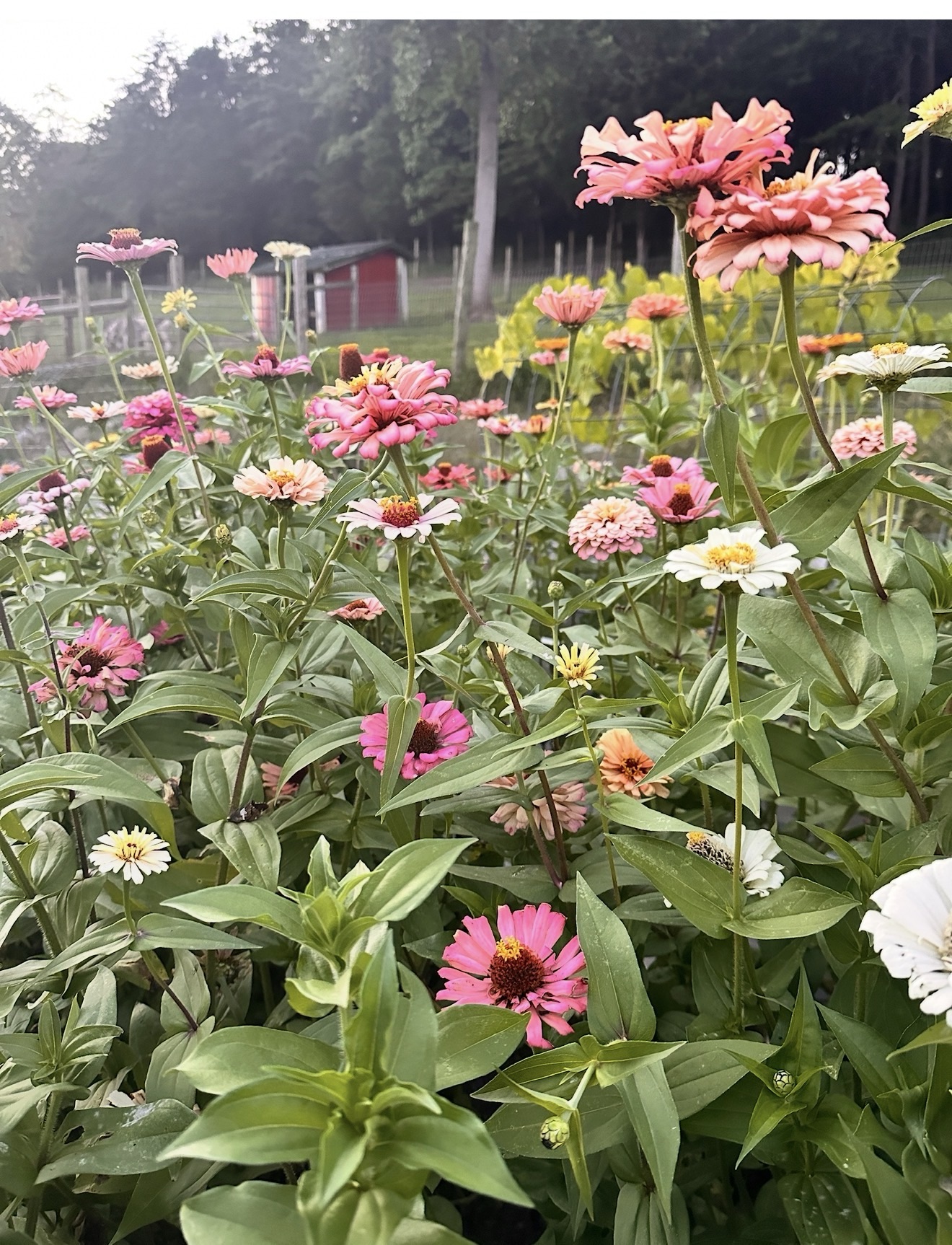
Zinnias
Pinch hard and early — the harder the pinch, the more blooms you’ll get back.
Cosmos
Pinch for sturdier branching so they don’t flop over once they’re tall.
Marigolds
Pinch young for a bushier plant and noticeably more flowers.
Strawflower
Pinch for more branching stems — worth it even though it feels early.
Sweet peas
Pinch once vines have 4–6 leaves for stronger, fuller growth.
Remove spent blooms to keep them going
No pinching needed when young. Once they bloom, just keep removing the spent flower — that’s what keeps them producing.
Roses
Cut the spent bloom back to the first set of 5 leaflets, at an angle.
Petunias
Pinch spent blooms off by hand. Leggy by midsummer? Cut the whole plant back by half.
Salvia
Cut the spent flower spike down to where new growth is already showing.
Coneflower & black-eyed Susan
Deadhead through the season — leave a few unclipped in fall for the goldfinches.
Geraniums
Pinch the spent flower, then the stalk back to where it meets the main stem.
Scabiosa
Branches on its own — no pinching needed, just keep cutting the spent blooms.
Harvesting is the only pruning they need
No pinching, no deadheading — cutting the stem for your vase does the whole job.
Lisianthus
Never pinch. Cutting the stem for a bouquet is all it ever needs.
Gomphrena
Same — skip the pinching, just harvest as it blooms.
Sunflowers (single-stem)
One bloom per stem. Cut at the base when it’s ready, no pinching involved.
Larkspur
Naturally multi-stem — harvest the whole spike when it’s open.
Poppies
Cut as they open. They don’t respond well to pinching, so don’t bother.
Crested celosia
The one celosia you don’t pinch — plume types do, this one doesn’t.
At a glance
Cutting it back isn’t cutting it short. It’s setting it up to come back fuller — and so is everything else worth tending right now.
— Jules & Lane