
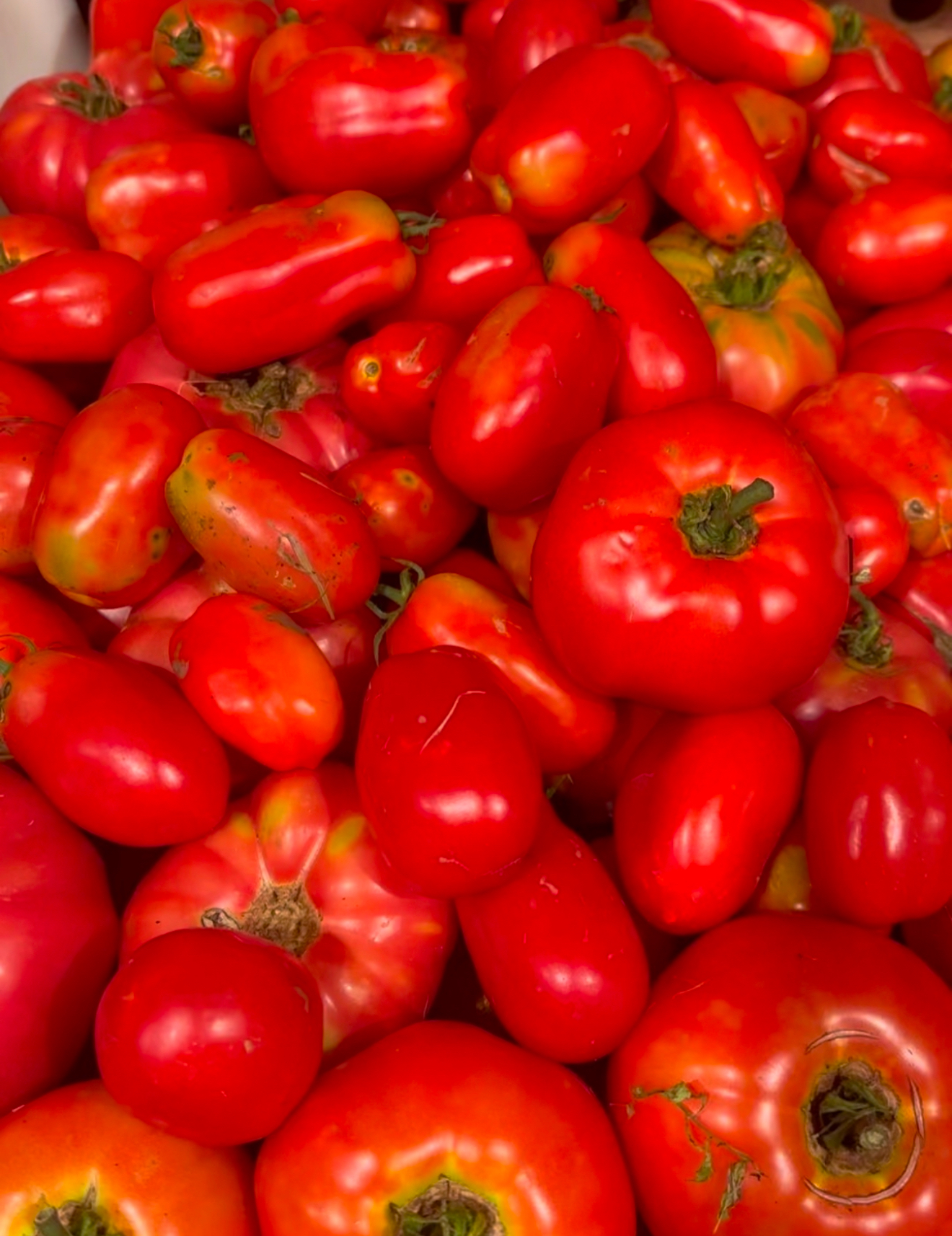
Determinate tomatoes grow to a set height, ripen everything in a few weeks, and then they are done. Indeterminate tomatoes keep growing and keep fruiting until frost. Determinate is what you want for canning and containers. Indeterminate is what you want for tomatoes on the counter all summer, and it is what most heirlooms are.
We grow both determinate and indeterminate tomatoes here at Sweet BombDiggity Farms — and understanding the difference changed everything about how we tend them. This guide is everything we wish we’d known from the beginning.
First Things First: What Does Determinate vs. Indeterminate Actually Mean?
When you’re standing in the garden center staring at a wall of tomato starts, “determinate” and “indeterminate” can feel like intimidating labels on a science test. But once you understand what they mean, every other decision — what to plant, how to stake it, when to harvest — gets a whole lot clearer.
In simple terms:
- Determinate tomatoes grow to a predetermined size, set all their fruit at roughly the same time, and then they’re finished for the season. Think of them as focused and efficient — one big, beautiful burst of tomatoes, then done.
- Indeterminate tomatoes keep growing, flowering, and producing fruit continuously from early summer right up until the first frost takes them. They’re the true climbers — vining plants that need consistent support all season long and just keep giving.
Neither is better. They’re just designed differently. And when you understand what you’ve got, you can give it exactly what it needs to flourish.
Determinate Tomatoes: The Focused Producers
How They Grow
Determinate tomatoes are compact, bushy plants — typically reaching 2 to 4 feet tall. They stop growing vertically once they set their terminal flower bud, which signals the plant to put all its energy into ripening fruit at once. The harvest window is usually 2 to 3 weeks of concentrated production, which makes them ideal for canning, sauces, and preserving.
Because their fruit ripens all at once, they can get heavy. The main stem alone often can’t support the weight of a full crop, so they do still benefit from a cage or stake — just not the tall, heavy-duty kind that a climbing indeterminate needs.
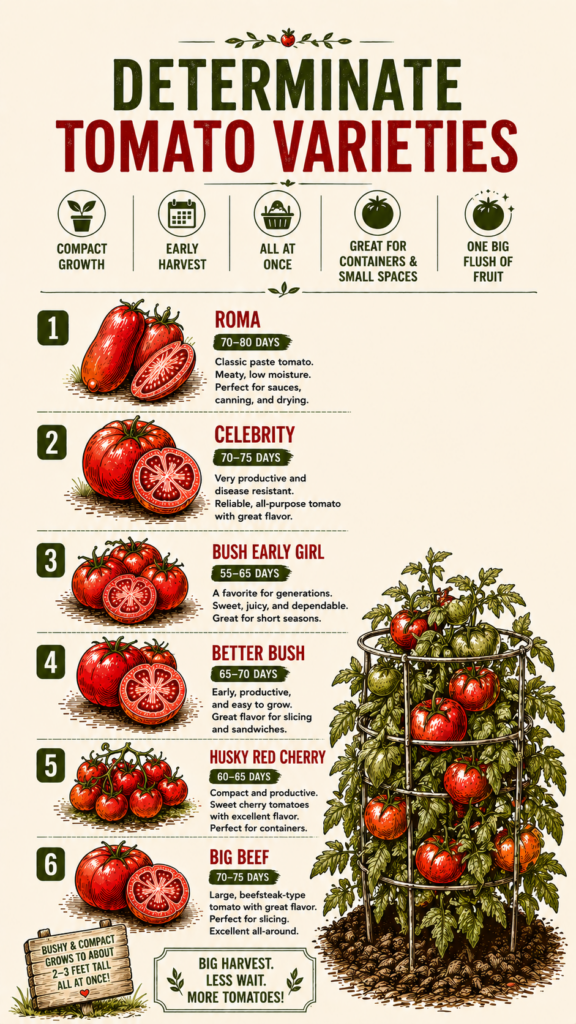
Popular Determinate Varieties
- Roma — The classic paste tomato. Meaty, low-moisture, perfect for sauce and canning. A workhorse in any kitchen garden.
- Celebrity — Disease-resistant and reliable. A great all-purpose slicer with a long track record.
- Rutgers — An old-school favorite with excellent flavor. Great for both fresh eating and canning.
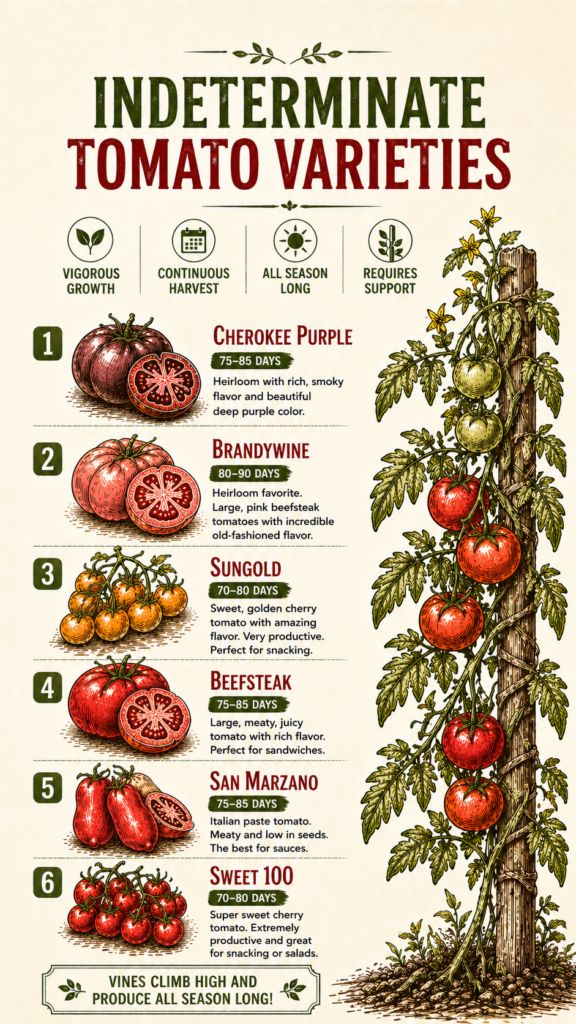
- San Marzano (determinate types) — Rich, sweet, and low in acid. The gold standard for Italian sauces. (Note: some San Marzano varieties are indeterminate — check your seed packet.)
- Marglobe — One of the oldest commercial varieties. Smooth, meaty, and dependable.
- Bush Early Girl — A compact version of the beloved Early Girl, ready about 54 days from transplant.
- Patio — Bred specifically for containers and small spaces. Great for porches and raised beds.
Best Uses for Determinate Tomatoes
- Canning and preserving — the all-at-once harvest makes processing efficient
- Making large batches of sauce or salsa
- Smaller garden spaces or container growing
- Gardeners who want a defined harvest season rather than ongoing picking
Support Needs
A sturdy tomato cage (the kind with 3 or 4 rings) works well for most determinate varieties. You can also use a short stake — about 3 to 4 feet — and loosely tie the main stem as it grows. You won’t need to do much pruning, and you won’t need to train them to climb.
Indeterminate Tomatoes: The Climbers and Season-Long Producers
How They Grow
Indeterminate tomatoes are true vines. They don’t stop growing — ever — until frost kills them. In ideal conditions, a single indeterminate plant can reach 6, 8, even 10 feet tall. They produce flowers and fruit continuously all season, which means you’re picking tomatoes from June through October rather than all at once.
This is what we grow at Sweet BombDiggity Farms. We train our heirloom indeterminates up cattle panel fencing, which gives them the height and consistent support they need. The trade-off for all that ongoing production is ongoing attention — they need to be pruned, trained, and tied up regularly throughout the season.
Popular Indeterminate Varieties
- Brandywine — The queen of heirloom tomatoes. Rich, complex flavor with a gorgeous pinkish-red fruit. Slower to produce but worth every day of the wait.
- Cherokee Purple — Deep, dusty-rose color with a smoky, rich flavor. Stunning on a plate and beloved by heirloom growers.
- Black Krim — Dark, slightly salty, and intensely flavored. A Russian heirloom that performs beautifully in heat.
- Sun Gold — A cherry tomato that produces cascades of sweet, orange fruit all season. If you plant nothing else, plant Sun Gold.
- Early Girl — Reliable, flavorful, and one of the first to ripen. A garden staple for good reason.
- Mortgage Lifter — A legendary heirloom bred by a man in West Virginia who paid off his mortgage by selling the plants. Huge fruit, incredible flavor.
- Green Zebra — A striped, tangy variety that’s ready to harvest while still green. A conversation piece and a flavor standout.
- Sungella — Yellow cherry tomatoes with a sweet, mild flavor. Beautiful in salads.
- Paul Robeson — A dark heirloom with a rich, almost wine-like flavor. One of the best for eating fresh off the vine.
Best Uses for Indeterminate Tomatoes
- Fresh eating all season long — there’s always something ripe
- Small-batch preserving throughout the summer
- Heirloom variety growing and seed saving
- Gardeners who want an ongoing harvest rather than one big haul
- Growers with vertical space — trellises, fences, cattle panels
Support Needs
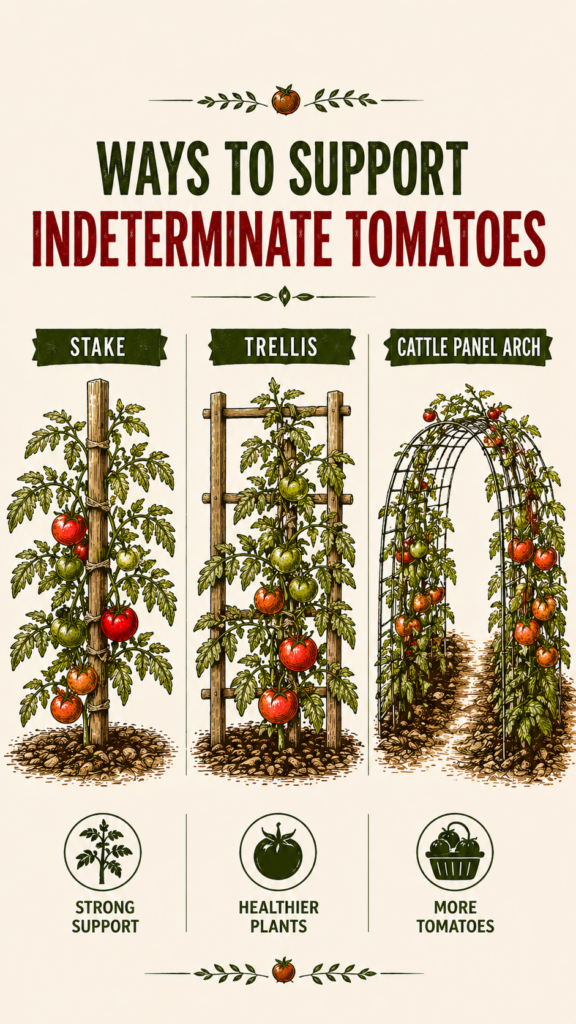
Indeterminates need serious, tall support — at minimum 5 to 6 feet, ideally more. Options include:
- Cattle panel fencing — Our method at SBD Farms. Sturdy, reusable, and gives plants plenty of room to climb and spread.
- Florida weave — A technique using wooden stakes and twine woven between plants in a row. Labor-efficient for larger plantings.
- Tall wooden or metal stakes — Simple and effective. Use soft ties or strips of fabric to secure the stem every 8 to 12 inches as it grows.
- Tomato cages (heavy-duty) — Standard store-bought cages are usually too small and flimsy for indeterminates. Look for heavy-gauge cages at least 5 feet tall, or make your own from wire fencing.
Planting Tomatoes: Getting Them Off to the Right Start
When to Plant
Tomatoes are warm-season plants and are very sensitive to frost. In most of the U.S., planting outdoors is safe once nighttime temperatures are consistently above 50°F. Here in East Tennessee, Mother’s Day (mid-May) is the traditional “safe date” — though we sometimes push it a week or two early if conditions look favorable.
If you’re growing from seed, start seeds indoors 6 to 8 weeks before your last frost date.
Choosing Your Location
- Full sun — Tomatoes need at least 6 to 8 hours of direct sunlight daily. More is better.
- Good drainage — They don’t like wet feet. Raised beds or well-amended in-ground soil works well.
- Air circulation — Crowded plants are more prone to disease. Give them room.
- Rotation — Don’t plant tomatoes (or peppers, eggplant, or potatoes) in the same spot two years in a row. Rotating reduces soilborne disease.
How to Plant
Tomatoes are one of the few vegetables that benefit from being planted deep. Bury the stem up to the lowest set of leaves — the buried portion will develop additional roots, giving you a stronger, more drought-tolerant plant.
- Dig a hole deep enough to bury the plant up to its lowest leaves.
- Remove any leaves that will be underground.
- Place the plant in the hole and backfill with soil, pressing gently to eliminate air pockets.
- Water well immediately after planting.
- Add a layer of mulch around the base (not touching the stem) to retain moisture and prevent soil splash, which can spread disease.
Spacing
- Determinate varieties: 18 to 24 inches apart
- Indeterminate varieties: 24 to 36 inches apart
What Tomatoes Need to Thrive
Soil
Tomatoes are heavy feeders and prefer rich, well-draining soil with a pH between 6.0 and 6.8. Before planting, work in plenty of compost. A slow-release balanced fertilizer worked into the soil at planting gives plants a strong start.
Watering
Consistent watering is one of the most important things you can do for tomatoes. Inconsistent moisture — too much, then too little, then too much again — leads to problems like blossom end rot and cracking.
- Water deeply and consistently — about 1 to 2 inches per week, depending on heat and rainfall.
- Water at the base of the plant, not the leaves. Wet foliage invites disease.
- Drip irrigation or a soaker hose is ideal.
- Mulch heavily to help retain soil moisture between waterings.
Fertilizing
- At planting: Work a balanced fertilizer or compost into the soil.
- Once flowering begins: Switch to a fertilizer lower in nitrogen and higher in phosphorus and potassium. Too much nitrogen at this stage produces lush foliage at the expense of fruit.
- Throughout the season: Feed every 2 to 3 weeks with a tomato-specific fertilizer or compost tea.
Pruning (Especially for Indeterminates)
Pruning is optional for determinates but important for indeterminates. The key thing to learn: suckers. Suckers are the small shoots that grow in the “V” between the main stem and a branch. Left alone, they become full branches — which means more foliage, more competition for energy, and a plant that’s harder to manage.
For indeterminates, pinch or cut suckers off when they’re small (under an inch). Most growers train indeterminates to 1 or 2 main stems for the best fruit production and airflow.
For determinates, leave the suckers alone — removing them can reduce your harvest.
Sunlight and Temperature
Tomatoes thrive in heat — but there are limits. Once daytime temperatures consistently exceed 90°F, or nighttime temperatures drop below 55°F, flowers may drop without setting fruit. This is temporary. When conditions return to the comfortable range (70s to low 80s during the day), fruit set will resume.
Common Tomato Pests — and What to Do About Them
Tomato Hornworm
Large, bright green caterpillars that can strip a plant of foliage seemingly overnight. Look for black droppings on leaves as an early warning sign. Hand-pick and destroy, or apply Bt (Bacillus thuringiensis), a natural bacterial insecticide that’s safe for beneficial insects.
Aphids
Tiny, soft-bodied insects that cluster on stems and the undersides of leaves. A strong blast of water knocks them off. Neem oil or insecticidal soap handles heavier infestations. Ladybugs love them — encourage beneficial insects in your garden.
Whiteflies
Tiny white-winged insects that fly up in a cloud when you brush the plant. They weaken plants and can spread disease. Yellow sticky traps help monitor populations. Neem oil is effective for control.
Spider Mites
Nearly invisible, but their damage isn’t — look for stippled, yellowing leaves and fine webbing on the undersides of foliage. Spider mites thrive in hot, dry conditions. Keep plants well-watered and use neem oil or insecticidal soap.
Stink Bugs
Shield-shaped insects that puncture fruit and cause cloudy, discolored spots beneath the skin. Hand-pick adults and egg masses. Row covers early in the season can help prevent infestation.
Cutworms
Soil-dwelling larvae that cut seedlings off at the base. Place a collar (a cardboard tube works great) around transplants at soil level to protect young plants.
Common Tomato Diseases — Prevention and Management
Blossom End Rot
Not a disease, but a calcium deficiency caused by inconsistent watering. The bottom of the fruit turns dark and leathery. Consistent, even moisture is the fix. Mulch helps. Calcium sprays are available but consistent watering addresses the root cause.
Early Blight
Dark spots with concentric rings on lower leaves, spreading upward. Remove affected leaves immediately. Avoid overhead watering. A copper-based fungicide can help slow the spread.
Late Blight
A more serious fungal disease — dark, water-soaked lesions on leaves and stems that spread rapidly in cool, wet conditions. Remove and destroy affected plants. Don’t compost them. Copper fungicide as a preventive helps in humid climates.
Septoria Leaf Spot
Small circular spots with dark borders and light centers, starting on lower leaves. Similar management to early blight — remove affected foliage, avoid wetting leaves, apply copper fungicide preventively.
Fusarium and Verticillium Wilt
Soilborne fungal diseases that cause wilting and yellowing. No cure once infected — prevention through crop rotation and choosing resistant varieties (look for “F” and “V” on the plant tag) is key.
Why are my tomatoes not turning red?
Almost always heat. Tomatoes ripen best between about 70 and 80 degrees. Once it climbs past 85, the plant stops making the pigment that turns fruit red and the whole thing stalls. The tomatoes are not failing, they are waiting you out. In an East Tennessee August that can last weeks.
- Give them shade in the worst of the afternoon. Shade cloth works. So does an old bedsheet.
- Water deeply in the morning so they can cope with the heat of the day.
- Mulch to hold moisture and keep the soil cooler.
- Bring them in to finish. Once a tomato shows the first blush of color it no longer needs the plant. Pick it and let it ripen on the counter, out of the heat. It will taste the same.
Harvesting Tomatoes
Tomatoes are ready to harvest when they reach their full color and give slightly to gentle pressure. Don’t wait for them to be perfectly soft — a little firmness means they’ll hold up better and continue ripening off the vine if needed.
A few tips:
- Harvest regularly, especially with indeterminates — frequent picking encourages more production.
- If frost threatens, pick any mature green tomatoes. They’ll ripen indoors on a countertop (not in the refrigerator — cold destroys flavor and texture).
- Heirloom varieties won’t always look picture-perfect. Cracking, unusual colors, and irregular shapes are normal and don’t affect flavor.
Quick Reference: Determinate vs. Indeterminate at a Glance
| Determinate | Indeterminate | |
|---|---|---|
| Growth habit | Bushy, compact | Vining, continuous |
| Height | 2–4 feet | 6–10+ feet |
| Harvest | All at once, 2–3 week window | Continuously until frost |
| Support needed | Cage or short stake | Tall trellis, cattle panel, or heavy stake |
| Pruning | Minimal — leave suckers | Regular — remove suckers |
| Best for | Canning, small spaces, defined harvest | Fresh eating, heirlooms, season-long production |
Tomato questions we get asked
What is the difference between determinate and indeterminate tomatoes?
Determinate types grow to a fixed height, set all their fruit in a short window, then stop. Indeterminate types keep growing and keep setting fruit until frost kills them. Determinate suits canning and containers. Indeterminate suits a steady supply through the season.
Are heirloom tomatoes determinate or indeterminate?
Almost all heirlooms are indeterminate. That is part of why they need real support and why they keep producing so long.
Why are my tomatoes not turning red?
Heat. Above about 85 degrees the plant stops producing the pigment that reddens the fruit, so ripening stalls until things cool off. Shade the plants in the afternoon, water deeply in the morning, and pick any tomato that has started to blush so it can finish indoors.
Should you prune tomato suckers?
Prune indeterminate tomatoes to keep them open and manageable. Leave determinate tomatoes mostly alone, because every branch you remove is fruit you will not get, and they only fruit once.
How deep should you plant a tomato?
Deeper than it was in the pot. Strip the lower leaves and bury the stem. Tomatoes grow roots all along a buried stem, so a deep planting makes a stronger, steadier plant.
Can you save a leggy tomato seedling?
Yes, and the trough method is the fix. Lay the plant on its side in a shallow trench with only the top few leaves above ground and cover the stem. It roots along its whole length and usually outgrows the ones planted upright.
What causes blossom end rot?
A calcium problem, but usually not a calcium shortage in the soil. Uneven watering keeps the plant from moving calcium to the fruit. Consistent moisture and mulch prevent it better than any amendment.
Which tomatoes are best for canning?
Determinate paste types like Roma. They ripen together, which is exactly what you want when you are putting up a batch rather than picking a few at a time.
The Bottom Line
There’s no wrong choice between determinate and indeterminate tomatoes — only the wrong support for the one you’ve got. Pay attention to what you’re growing. Give it what it needs. And then get out of the way and let it do what it was designed to do.
That’s pretty good advice for the garden. Honestly, it’s pretty good advice for life too.
Happy growing, friends.
— Jules + Lane | Sweet BombDiggity Farms
Growing tomatoes in East Tennessee or a similar climate? Drop your questions in the comments — we love talking all things garden. And if you found this guide helpful, share it with a fellow grower.
Heirlooms are worth a spot either way, and here is why we grow them. If your seedlings got tall and floppy, try the trough method for leggy tomato plants.
While you’re here, take a look at Determinate vs. Indeterminate Potatoes: Everything You Need to Know to Grow, Hill, and Harvest Like You Mean It and All you need to know about Cucumbers!.
Planning your vegetable garden? Our Growing Vegetables guide brings all of our crop, heirloom, soil and seed starting posts together, and Garden by the Season shows what to do and when.


Written by
Lane and Jules Morris
Authors and University of Tennessee faculty writing from our farm in East Tennessee about gardening, the farm kitchen, faith and designing a flourishing life at any age. More about us

2 Responses
Great information! Straight, to the point easy to understand instructions, very helpful for a newbie. Thanks a bunch!
This guide has been very helpful. Thank you