
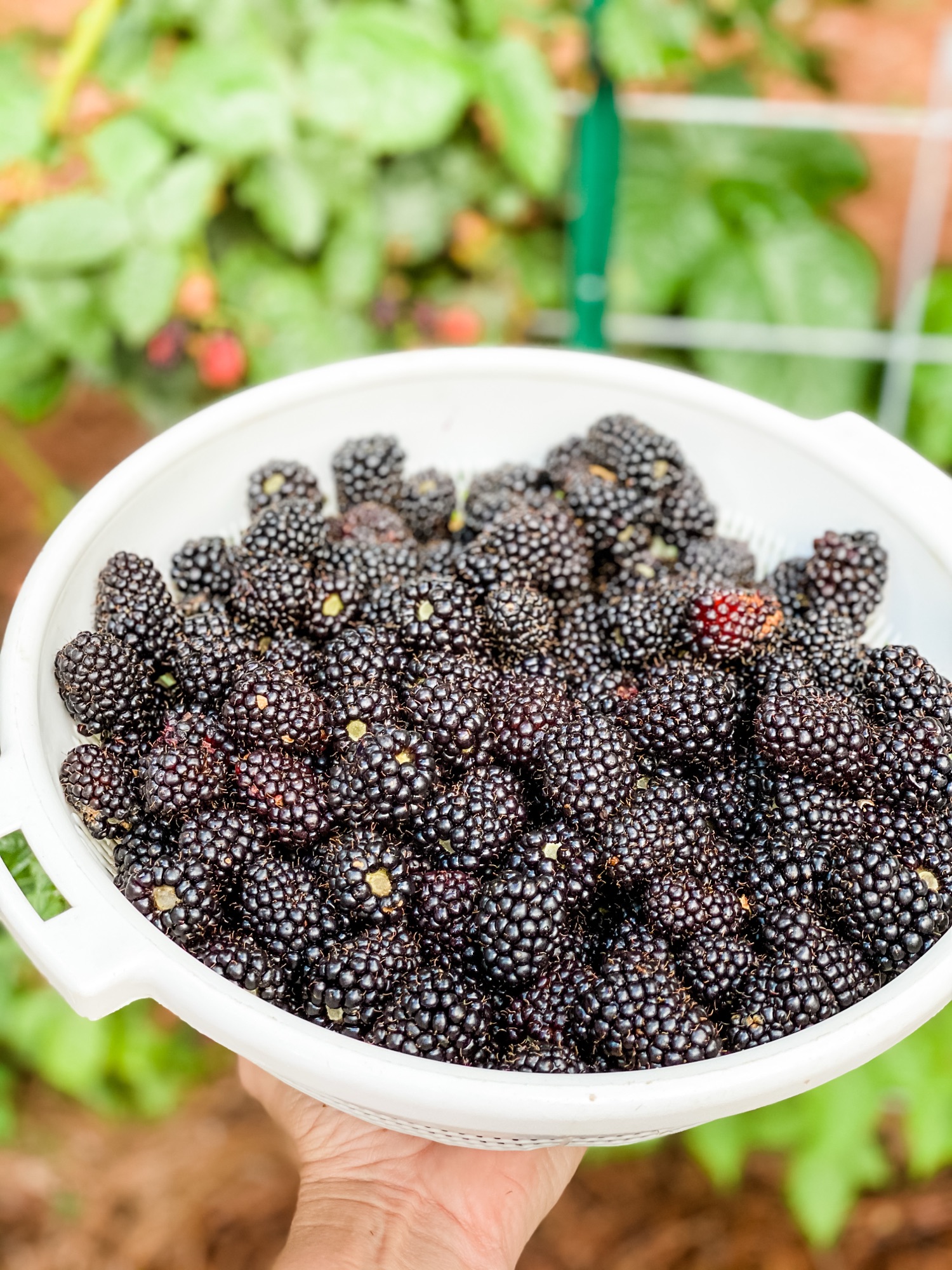
We didn’t set out to write a book about berries or even one single berry. It started with one video about telling a primocane from a floricane, and then another about what to actually cut, and before long the comments were full of the same questions over and over. What about raspberries? What about the ones with both kinds of leaves on the same cane? What about the berries nobody talks about?
So we gathered it all up. Every berry we’ve covered this season, plus the ones we hadn’t gotten to yet, planting basics, care, pruning, harvest and wash tips, all in one place. Blackberries, raspberries, wineberries, strawberries, blueberries, mulberries, elderberries, currants, gooseberries, aronia, serviceberries and honeyberries. If it grows on a cane, a shrub, or a tree in a home garden, it’s probably in here.
We’re writing from East Tennessee, but this guide isn’t just for East Tennessee. Every berry lists a general hardiness zone so you can check it against wherever you’re growing, because a flourishing garden doesn’t look the same in every backyard, and it doesn’t need to.
That’s really the whole idea behind this place. Designing a life, and a garden, that actually fits the one you’ve got. Not someone else’s version of it.
A note on your growing zone
We’re writing from East Tennessee, but this guide is for growers everywhere. Every berry notes a general USDA hardiness range, so check it against your own zone. Pruning timing may shift a few weeks with your local frost dates, but the rules stay the same.
What about grapes? Botanically, grapes are true berries too, but they’re trained on cordons and spurs, a completely different system from canes or shrub wood, so they didn’t make this edition. They deserve a guide of their own, and ours is coming soon.
Blackberries (Rubus fruticosus)
Blackberries grow on a two-year cane cycle, which means the plant you’re looking at today is doing one of two jobs: growing, or fruiting. Learning to read the leaves is the whole game.
- 5 leaflets = primocane. This year’s growth, next year’s fruit.
- 3 leaflets = floricane. Fruiting now, done after harvest.
Before you apply the rule, check your variety. Most blackberries are floricane-only, so the rule above is all you need. Primocane-fruiting varieties like Prime-Ark are the exception. They fruit in their first year, so there’s no floricane to preserve. For those, cut the entire planting to the ground each winter and let new primocanes fruit the following season.
- Planting. Hardy in zones 5 to 9 depending on variety. Full sun, at least 6 to 8 hours a day. Well-drained soil, slightly acidic to neutral (pH 5.5 to 7). Space plants 3 to 4 feet apart in rows 8 to 10 feet apart. Plant in early spring or fall while dormant.
- Care and needs. One to two inches of water per week, more during fruiting. A trellis or wire support keeps canes off the ground. Mulch to retain moisture and suppress weeds. Feed in early spring with a balanced fertilizer.
- Pruning. Three leaflets (floricanes): cut all the way to the ground once they finish fruiting, because they will not fruit again. Five leaflets (primocanes): top off at 3 to 4 feet to encourage lateral shoots, which is where next year’s berries form. Thin out weak or crowded canes to improve airflow.
- Harvest and wash. Pick when berries are fully black and release easily with a gentle tug. A berry that resists isn’t ready. Rinse just before eating in a colander under cool water and skip soaking, which turns them mushy. Pat dry, and store unwashed berries in the fridge for the best shelf life.
Raspberries (Rubus idaeus)
Same family, same primocane and floricane system as blackberries, but keep an eye out for everbearing varieties, which add a second fruiting window into the mix.
Before you apply the rule, check your variety. The 3/5 leaflet rule assumes a standard, floricane-only variety. Everbearing raspberries are the exception: their 5-leaflet primocanes fruit in fall of year one, then can fruit again next summer as a floricane. Check the tag if you’re unsure.
- Planting. Hardy in zones 3 to 8 depending on variety. Full sun, though it tolerates a little afternoon shade in hot climates. Rich, well-drained soil, pH 5.6 to 6.2. Space plants 2 to 3 feet apart in rows 6 to 8 feet apart. Plant bare-root canes in early spring.
- Care and needs. Consistent moisture, roughly 1 to 2 inches per week. Support with a trellis, especially in windy spots. Mulch heavily, because shallow roots dry out fast. Thin new shoots to keep rows from overcrowding.
- Pruning. Three leaflets (floricanes): cut to the ground after fruiting, same as blackberries. Five leaflets (primocanes): top at 3 to 4 feet for lateral shoots. Everbearing types: cut to the ground each winter for one crop, or leave standing for a second smaller crop next summer.
- Harvest and wash. Ripe raspberries slide off the core with barely a touch. If you’re tugging, it’s not ready. They’re delicate and don’t hold up to soaking, so rinse gently right before you eat or use them, then let them air dry on a towel rather than rubbing them.
What about black raspberries? They don’t follow the 3/5 rule. Go by cane texture instead: primocanes are green with a waxy bloom, and floricanes darken and turn woody in year two.
Wineberries (Rubus phoenicolasius)
A raspberry relative with the same three-and-five-leaflet system, but one important difference before you plant a patch on purpose.
A note before you plant. Wineberries are considered invasive in many areas of the U.S. Their cane tips root readily wherever they touch soil, so they spread fast and aggressively. Check your local extension office before introducing them, and if you already have some, lean toward controlling spread rather than encouraging it.
- Planting and care. Hardy in zones 5 to 8. Full sun to partial shade, and very adaptable. Tolerates poor soil better than most brambles. Contain the patch with a buried root barrier or a mowed border. Pin cane tips up off the ground if you want to limit rooting.
- Pruning. Same floricane-fruiting pattern as raspberries. Three leaflets: cut to the ground after fruiting. Five leaflets: top off to control size and spread, not just to boost fruit.
- Harvest and wash. The fuzzy red husk splits open as the berry ripens underneath. Pick once the berry itself has fully colored and pulls away easily. Wash gently just before eating, same as raspberries.
Strawberries (Fragaria × ananassa)
No canes here. Strawberries spread by runners, and the biggest thing that separates good beds from great ones is knowing your type and renovating on schedule.
- June-bearing. One big crop, needs annual renovation.
- Everbearing / day-neutral. Smaller crops all season, no renovation cut.
- Planting. Hardy in zones 3 to 10 depending on variety. Full sun, at least 6 to 8 hours a day. Rich, well-drained soil, pH 5.8 to 6.5. Plant in early spring and space 12 to 18 inches apart. Pinch off first-year flower buds so the plant establishes instead of fruiting too early.
- Care and needs. About an inch of water per week, steady and even. Mulch with straw to keep berries clean and off wet soil. Control runners, letting a few root to fill the bed and snipping the rest. Replace a bed every 3 to 4 years as yields decline with age.
- Pruning (renovation). June-bearing: immediately after harvest, mow or cut foliage down to about an inch above the crown, then thin to 4 to 6 inches between plants. Everbearing and day-neutral: skip the hard renovation cut and just remove runners and dead foliage as you go.
- Harvest and wash. Pick when berries are fully red all the way to the cap, since strawberries don’t ripen further once picked. Leave the green cap on until you’re ready to eat or use them. Rinse gently under cool water right before eating, then hull. Washing ahead of time speeds up mold.
Blueberries (Vaccinium spp.)
A different animal entirely. Blueberries don’t run on the primocane and floricane cycle at all. They’re a slower-growing shrub that fruits on wood that’s a couple of years old.
- Planting. Hardy in zones 3 to 9 depending on type (highbush 3 to 7, rabbiteye 6 to 9). Full sun, 6 to 8 hours minimum. Acidic soil is non-negotiable at pH 4.5 to 5.5. Plant more than one variety nearby for cross-pollination and better fruit set. Good drainage matters, so avoid low spots that stay soggy.
- Care and needs. Feed in early spring with an acid-loving fertilizer; azalea and rhododendron blends work. Mulch with pine bark or pine needles, which holds moisture and keeps soil acidic. Test soil pH periodically and amend with elemental sulfur if it drifts too high. Be patient, because bushes often take five or more years to hit a real stride.
- Pruning. No leaflet-counting here; it’s about wood age, not canes. Prune in late winter while dormant. Remove the oldest, grayest canes at the base once they’re past their prime, typically 5 to 6 years old. Thin crossing branches so light and air reach the center of the bush.
- Harvest and wash. A ripe blueberry is fully blue with a dusty pale bloom and drops into your hand with barely a touch. Wash right before eating, not before storing, because excess moisture speeds up mold in the fridge. A quick rinse and pat dry is all they need.
Mulberries (Morus spp.)
A tree, not a bramble or a shrub. Mulberries are about the easiest fruit on this list to grow, and pruning is mostly about keeping the harvest within arm’s reach.
- Planting. Hardy in zones 4 to 9 depending on species. Full sun, at least 6 hours a day. Adaptable to most soils, preferring well-drained, slightly acidic to neutral ground. Space 15 to 30 feet apart for standard varieties, or 6 to 10 feet for dwarf types. Keep them away from walkways and parking, because dropped fruit stains.
- Care and needs. Deep, regular watering the first season to establish, then low-maintenance after that. Light annual feeding is usually plenty. Hardy and largely pest and disease resistant once established. Root-prune or trench at the drip line if it starts crowding its space.
- Pruning. Prune while dormant, late winter to early spring, before buds turn green. Top back to control height and keep fruit within reach; it responds with stronger lateral branches. Remove dead, damaged, or crossing branches for airflow. Avoid cuts over 2 inches across, because mulberry bleeds sap heavily from large wounds. An optional summer prune in July, cutting new growth back by about half, keeps the tree bushy and pickable.
- Harvest and wash. Mulberries don’t ripen further once picked, so wait until they’re fully colored and slightly soft. The easiest harvest method is laying a sheet under the tree and gently shaking the branches, since ripe berries drop right off. Rinse just before eating. They’re delicate and juice easily, so handle gently and don’t let them sit wet.
Elderberries (Sambucus canadensis)
Elderberry is a shrub, not a cane-fruiter, and its whole rhythm is slower and more forgiving than a bramble patch.
- Planting. Hardy in zones 3 to 9. Full sun to partial shade. Adaptable to a wide range of soils, preferring moist, well-drained ground. Space plants 6 to 8 feet apart, because they get big. Plant two different varieties for reliable pollination.
- Care and needs. Consistent moisture, especially the first two seasons. Mulch well, since shallow roots appreciate the protection. Light feeding in spring is usually enough, because elderberry isn’t a heavy feeder. Net the clusters if birds start beating you to the harvest.
- Pruning. Prune in late winter while fully dormant. It fruits on second-year and older wood, not on a strict annual cycle. Remove canes three years or older, as they lose productivity with age. Thin weak or crossing growth to keep the center open.
- Harvest and wash. Harvest whole clusters once berries are deep purple-black and the cluster droops under its own weight. Elderberries must be cooked before eating. Never eat them raw. Rinse clusters well, then strip berries from stems (a fork works well) before cooking down.
Currants and gooseberries (Ribes spp.)
Close cousins, grown and pruned the same way. Compact, cold-loving shrubs that fruit on older wood, not on canes. A great fit for a spot with a little afternoon shade.
- Planting. Hardy in zones 3 to 8. Both dislike hot, humid summers, so this is a cool-climate crop. Full sun in cooler areas, afternoon shade where summers run hot. Rich, well-drained soil, pH 6 to 6.5. Space plants 3 to 5 feet apart.
- Care and needs. Consistent moisture, and mulch well to keep roots cool. Light annual feeding in early spring. Good airflow matters, because both are prone to powdery mildew in stagnant, humid spots. Check local restrictions before planting, since some states limit currants as a pine blister rust host.
- Pruning. Prune while dormant in late winter. Fruits best on wood that’s 1 to 3 years old. Remove any wood older than 3 years at the base each year. Aim to keep 8 to 10 productive canes per bush, a mix of ages. Thin crowded centers for airflow and easier picking.
- Harvest and wash. Currants ripen in clusters (strigs) and are ready when fully colored and slightly soft; strip the whole cluster off and destem after. Gooseberries are ready when they give slightly to a gentle squeeze. Tartness varies by variety, and some are best picked a little under-ripe for cooking. Rinse both gently just before use.
Aronia, or chokeberry (Aronia melanocarpa)
A native North American shrub that’s about as low-maintenance as fruit gets, along with some of the highest antioxidant levels of any berry. The name comes from the fruit’s dry, puckering taste fresh off the bush, so most people cook or juice it rather than eat it raw.
- Planting. Hardy in zones 3 to 9 and extremely cold and heat tolerant. Full sun to partial shade. Adaptable to nearly any soil, including wet spots. Space plants 4 to 6 feet apart.
- Care and needs. Self-pollinating, so a single bush will still fruit. Minimal feeding needed, and avoid over-fertilizing. Naturally resistant to most pests and diseases. Little watering needed once established.
- Pruning. Prune while dormant in late winter. Very low-maintenance, mainly removing dead, damaged, or crossing branches. Once mature, around year 4 or 5, remove a few of the oldest stems at the base each year to keep new growth coming. It can be cut back hard if it outgrows its space, and it recovers well.
- Harvest and wash. Clusters ripen to a deep black-purple in late summer and can hang on the bush for weeks without spoiling, so there’s no rush. Rinse well before use. Fresh berries are quite astringent, so most people cook them into jams, syrups, or juice rather than eating them out of hand.
Serviceberries and honeyberries
Amelanchier spp. and Lonicera caerulea. Two different plants, grouped here because they share the same appeal: native or near-native, very cold hardy, and about as hands-off as fruit growing gets once established.
- Planting. Serviceberry: zones 4 to 9, full sun to partial shade, adaptable to most soils, growing as a large shrub or small tree, spaced 6 to 15 feet depending on type. Honeyberry: zones 2 to 7, very cold hardy but struggles in hot, humid summers; plant two different varieties for pollination and space them 4 to 5 feet apart.
- Care and needs. Both are low-input once established and need minimal feeding. Serviceberry tolerates drought well, while honeyberry prefers consistent moisture. Net bushes if birds are beating you to the harvest, a common problem with both.
- Pruning. Prune both while dormant in late winter. Serviceberry: thin oldest stems at the base every few years and treat it like a multi-stem shrub, not a cane fruiter. Honeyberry: minimal pruning for the first 3 to 4 years, then remove oldest wood at the base to keep it productive.
- Harvest and wash. Serviceberries ripen to a deep reddish-purple and taste like a cross between a blueberry and an almond; harvest by hand or strip clusters onto a sheet. Honeyberries are ready when fully deep blue inside and out, and the skin colors before the inside is ripe, so taste-test before a full harvest. Rinse both gently just before eating.
Know your cane, at a glance
The leaflet rule (blackberries, raspberries, and wineberries)
Three leaflets means the cane is a floricane, fruiting now or about to. Once it finishes fruiting, cut it to the ground. Five leaflets means the cane is a primocane, first-year growth. Top it off at 3 to 4 feet to push out lateral shoots, which become next year’s fruit.
When the 3/5 rule doesn’t apply as-is
- Everbearing raspberries and primocane-fruiting blackberries like Prime-Ark fruit on first-year, 5-leaflet growth instead of waiting to become a floricane. Check your variety tag before pruning.
- Wineberries are floricane-only, so the rule applies as written.
- Black raspberries are mostly 3-leaflet on both primocanes and floricanes, so leaflet count doesn’t distinguish them. Go by cane color and texture instead.
A cane with both? Totally normal. That’s a floricane showing older five-leaflet growth and newer three-leaflet growth now that it’s shifted into fruiting mode. Cut it down once it’s done fruiting.
Propagating from cut tips. Yes, and tip layering (bending a tip down and burying it in soil while still attached to the parent) roots far more reliably than a loose cutting. Give it a few extra weeks after roots form before severing it from the mother plant.
No leaflet rule. Strawberries spread by runners. Blueberries, elderberries, currants, gooseberries, aronia, serviceberries, and honeyberries are shrubs. Mulberries are a tree.
When to prune. Brambles: cut floricanes right after fruiting. Shrubs and trees: prune in late winter, fully dormant.
Take the printable version with you
Here’s the whole guide as a PDF. Grab your copy and keep it close all season. Consider it your go-to for whatever’s ripening, or about to be.
Now that’s BombDiggity!
Pull up a chair and join us at the Country Living Connoisseur for more like this, delivered straight to your inbox every other week. Gardening, farm life, and the occasional detour into whatever we’re figuring out next.
- 25 years and a pan of pumpkin muffins
- What looks finished usually isn't
- You might be cutting at the wrong time (Country Living Connoisseur)
- Some things you cut on instinct. Some you have to look for. (Country Living Connoisseur)
- We chose this. Even the sweating! (Country Living Connoisseur)
- Deep Roots, Hot Season (Country Living Connoisseur)
- On the Cusp of Blooming (Country Living Connoisseur)
- The reset is the point (Country Living Connoisseur)
- The garden doesn't lie. Here's what it's teaching us. (Country Living Connoisseur)
- Some say tomato, some say potato…
Want to keep reading? Try The Complete Hydrangea Guide, or Determinate vs. Indeterminate Tomatoes: Everything You Need to Know to Grow a Better Harvest.
Planning your vegetable garden? Our Growing Vegetables guide brings all of our crop, heirloom, soil and seed starting posts together, and Garden by the Season shows what to do and when.


Written by
Lane and Jules Morris
Authors and University of Tennessee faculty writing from our farm in East Tennessee about gardening, the farm kitchen, faith and designing a flourishing life at any age. More about us
